
Everyone’s talking about a crash. Almost nobody has a plan. Here are the 3 questions to answer this week.
Fear is back, and the Fed decides in 9 days. A crash call is a guess. A plan is three answers: what kind of market this is, how exposed you are, and what you’ll do if it turns.
The S&P 500 since 1999: three falls that started as a dip
Shaded: from the record close to the lowest close that followed. Log scale, so equal drops look equal.
Ten days after the S&P 500 set a record, fear came back fast. On Friday, October 16, the VIX, Wall Street's fear gauge, jumped 21% in a day to 20. The Nasdaq ended its worst week since June. The crash headlines followed.
Most of those headlines make a call. A crash call is a guess: it needs the timing right, and nobody knows the timing. A plan works either way. It comes down to three answers, and the week of the Fed is the time to have them.
Question 1 of 3
Is today Risk ON or Risk OFF?
A market regime is the kind of market you are in. It is not a forecast for next week. It is a read on the conditions under the prices today.
In a Risk ON market, money is flowing into stocks, borrowing is easy and dips tend to get bought. In a Risk OFF market, money is pulling back, credit gets tight and dips tend to run deeper and last longer. The same 2% drop means something different in each.
In a Risk ON market
Money is flowing, credit is calm, the trend is up
- A dip is more likely to be just a dip
- Selling into it can lock in the loss
- Investors stay invested and keep their core
In a Risk OFF market
Money is leaving, credit is cracking, the trend has turned
- A dip can turn into a long fall, like 2000–02 or 2022
- Investors cut what is most exposed
- They keep cash ready to buy back lower
Look again at the chart at the top. Each of those three falls began at a record, and in the first weeks each looked like an ordinary dip. The S&P 500 went on to fall 49%, 20% and 25%.
That is why question 1 comes first. It is also the one most investors only answer in hindsight, after the damage is done.
Question 2 of 3
How exposed am I?
The S&P 500 weights each company by its size, so the biggest companies move it most. As of October 16, the ten biggest positions in the largest S&P 500 fund were all AI-linked companies, and together they were 38.5% of it.
Add the chipmakers, data-center builders and AI software firms further down the list, and the AI share is about 45% by Goldman Sachs' count and about half by ours. That exposure is easy to miss, because much of it sits inside funds. An investor who holds an S&P 500 fund and a few AI stocks can own the same companies twice.
How much of the S&P 500 rides on AI
Share of the index's value, Oct 16
Where AI exposure hides
Three places to look, in stocks and in funds
- Stocks held directly: the AI companies in a portfolio
- Index funds: about half of an S&P 500 fund rides on AI, 38.5% in its top 10 alone
- Overlap: the same company held twice, once directly and once inside a fund
The week of October 12–16 showed what that means. The tech-heavy Nasdaq fell 4.5%. The Dow rose 0.7%. Same market, same week, very different results, depending on how much AI each one held.
Question 3 of 3
What will I do if it turns?
This is the answer most plans skip. A rule written down on a calm day is easier to follow on a scary one. Here are three simple rules many investors use, and how each one reads in a Risk ON week and in a Risk OFF week.
Hold the core
Long-term holdings, kept through the noise
- Risk ON week
- Hold
- Risk OFF week
- Hold
Trim concentration
A limit per stock or theme, set in advance
- Risk ON week
- Let it run to the limit
- Risk OFF week
- Trim back to the limit
Keep cash ready
Money set aside to buy at lower prices
- Risk ON week
- Use it on dips
- Risk OFF week
- Hold it for lower prices
The rules are the easy part. The hard part is knowing which week this is. That is question 1 again, and the answer can change within days.
The week of the Fed: the dates to plan around.
Oct 27
Durable goods orders, new home sales and consumer confidence
Oct 28
Fed rate decision at 2 p.m. ET, then the press conference
Oct 29
Q3 GDP and September inflation (PCE)
Late October
Microsoft, Alphabet, Meta, Apple and Amazon earnings (expected)
Nov 3
US midterm elections
Before October 28
Three answers, written down
- Question 1: is today Risk ON or Risk OFF? Check it again after the Fed
- Question 2: add up the AI share, in stocks and in funds
- Question 3: one rule each for the core, the biggest bets and the cash
- Check all three again after Big Tech earnings
What a plan is not.
Everyone says a crash is coming. Shouldn’t I just sell?
A crash call is a guess about timing, and timing is the one part nobody knows.
Selling everything is a plan too, just a risky one. If the market is still Risk ON, selling into a dip can lock in the loss and miss the rebound.
Isn’t it safer to wait until things calm down?
Waiting is also a decision, with its own risk. By the time things feel calm, prices have usually moved.
A plan decides in advance what would change the answer, so the decision isn’t made on the scariest day.
How would I know if the market turns?
Not from one headline, and not from the index itself. It is usually the last place a turn shows up.
That is what a daily Risk ON / Risk OFF read is for: one answer every morning, before the market makes it obvious.
Risk ONRisk OFF
Fear without a plan is panic. Market Intelligence gives the plan its missing input every morning.
Risk ON or Risk OFF, what changed and what it means, plus exposure guidance.
Current regime
Updated every morning
- Liquidity??.?
How much money is moving through the financial system — the fuel behind every rally.
- Capital Stress??.?
Early-warning signs from credit markets — where trouble shows up before it reaches stocks.
- Cycle??.?
Where the economy sits in its cycle — growth, inflation and interest-rate momentum.
- Sentiment??.?
How fearful or greedy investors are — the extremes that mark tops and bottoms.
What you get
- A daily Risk ON / Risk OFF call on the S&P 500
- When to hold and when to step aside, in plain words
- Daily macro briefings: rates, inflation, oil and the AI trade
- Exposure guidance for Risk ON and Risk OFF markets
- Built from millions of macro data points
Built on institutional‑grade data and leading AI.
The same data sources and models the big desks use, read for you every morning.



As seen on Yahoo Finance.
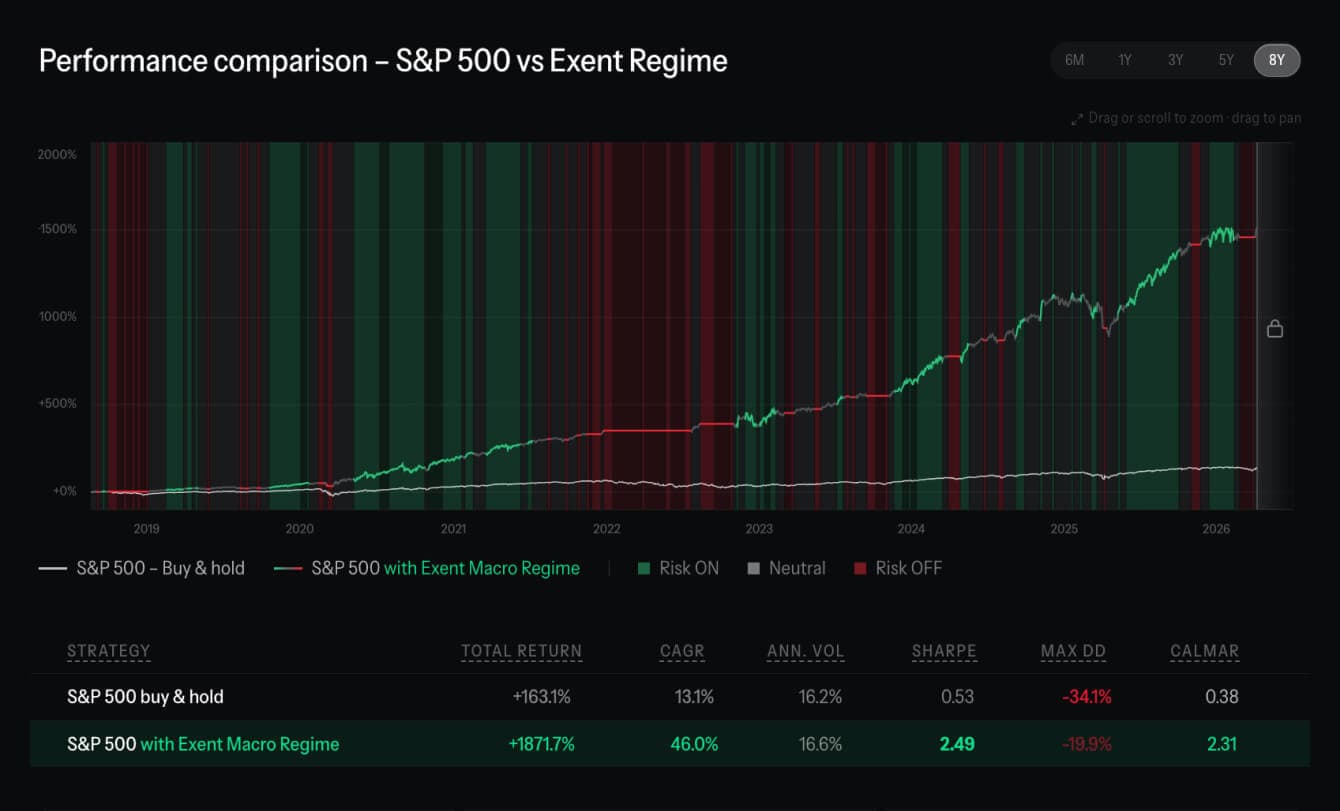
“Exent AI Beat S&P 500 by 10x Over 8 Years”
An eight-year performance analysis of Exent AI’s market regime signal against the S&P 500, as published on Yahoo Finance.
Read full article
Sources
- Yahoo Finance, Markets news, Oct 16, 2026: Nasdaq, S&P 500 post weekly losses (index closes, VIX)
- CNN, Nasdaq sinks more than 2% as investors raise questions about AI debt (Oct 16, 2026)
- CNBC, Stock market today, Oct 5–6, 2026 (S&P 500 record close)
- SPDR S&P 500 ETF (SPY) holdings, as of Oct 16, 2026
- 24/7 Wall St., AI share of the S&P 500 (Goldman Sachs basket) (Oct 12, 2026)
- Federal Reserve, FOMC meeting calendar (Oct 27–28, 2026)
- U.S. Bureau of Economic Analysis, release schedule (Q3 GDP and September PCE, Oct 29, 2026)
- WJLA Fact Check Team, the Nov 3, 2026 midterm elections
- FRED (St. Louis Fed): S&P 500 history