
An AI company’s bonds now pay over 15%. In 2007, credit cracked three months before stocks peaked.
The AI boom runs on borrowed money. What the bond market is saying now, what happened the last two times a borrowing boom cracked, and the dates to watch.
What lenders charge
Yield on each borrower’s bonds. The riskier the borrower, the more lenders want.
Lenders decide every day whether they will get their money back. When they start to worry, they charge more. This week they charged one AI company more than 15% a year to borrow, about three times what the US government pays.
One company's bonds are not a crash signal. But in 2007 the first cracks also showed up in one corner of the bond market, three months before stocks peaked. Here is what happened then, what is different now, and the dates to watch.
The AI boom runs on borrowed money. This week, the lenders got nervous.
AI needs data centres, chips and power, and the bills are enormous. The cash the big tech companies earn no longer covers all of it, so more and more of the build-out is paid for with debt. Here is the chain, from the spending to the people who carry the risk.
Spend
The big cloud firms spend about $800 billion this year, much of it on AI (JPMorgan estimate)
Borrow
Alphabet, Amazon, Meta and Oracle sold over $228 billion of bonds in 2026, more than double 2025
Stretch
Smaller AI clouds such as CoreWeave borrow at junk rates. It paid $640 million in interest last quarter
Hold the risk
Bond funds, insurers, banks and private lenders, and everyone who owns the stocks
CoreWeave’s interest bill, per quarter
An AI cloud that rents out Nvidia chips, rated junk (B+)
It is not only CoreWeave. The Financial Times reported this week that bonds which paid for big data-centre projects were trading below face value. When lenders get nervous, a company that relies on borrowing has three choices: pay more, build less, or sell shares. Stockholders feel all three.
In 2007, credit cracked first. Stocks hit a record anyway, then fell 57%.
The S&P 500 since 1999, and the last two borrowing booms
Shaded: from the record close to the lowest close that followed. Log scale, so equal drops look equal.
2007. The borrowing boom was in mortgages. Banks bundled home loans into bonds and sold them around the world. The first cracks showed up in June, inside two Bear Stearns hedge funds that had borrowed heavily to buy those bonds.
Stocks barely noticed. The S&P 500 wobbled over the summer, then closed at a record on October 9. Lenders had been asking for more for months by then: the extra yield on medium-grade company bonds over Treasuries rose from 1.59 points in mid-July to 2.13 by mid-September. Seventeen months after the record, the S&P 500 was down 57%.
Jun 22, 2007
Bear Stearns commits up to $3.2 billion to rescue one of its mortgage hedge funds
Jul 17, 2007
Investors are told the two funds are worth almost nothing
Aug 9, 2007
BNP Paribas freezes three funds it can no longer value
Oct 9, 2007
The S&P 500 closes at a record: 1,565
Mar 9, 2009
The S&P 500 bottoms at 677, down 57%
2000. The borrowing boom was in telecom. Companies raced to lay fiber-optic cable for an internet they were sure would explode, and US telecom firms borrowed more than $320 billion between 1999 and 2001.
The internet did change everything. But by April 2001, less than 3% of the long-distance fiber was in use. The loans could not be paid, telecom defaults soared, and the Nasdaq fell 78% from its March 2000 record to its October 2002 low.
The last two borrowing booms, and now
What was borrowed, and what stocks did after the peak
| The borrowing boom | What followed | |
|---|---|---|
| 2000–02 | Telecom fiber: over $320B borrowed in 1999–2001 | Nasdaq −78% · S&P 500 −49% |
| 2007–09 | Mortgages: credit cracked in June and July, stocks peaked Oct 9 | S&P 500 −57% |
| Now | AI data centres: $228B+ of new bonds in 2026, one AI cloud pays 15%+ | ? |
One borrower in trouble, or the start of a credit crack?
In June 2007 the trouble also looked like a special case: two hedge funds at one bank. Most of the time, one borrower's trouble stays one borrower's trouble. Sometimes it spreads, from the weakest borrower to the next and from bonds to stocks. From the inside, the first weeks of both look the same.
If the market is Risk ON
Credit is calm, money is flowing, the trend is up
- One borrower’s trouble tends to stay contained
- Dips in AI stocks tend to get bought
- Investors stay invested and keep their core positions
If the market is Risk OFF
Lenders pull back, credit cracks, the trend has turned
- Stress spreads from the weakest borrowers to the rest
- A dip can turn into a long drawdown, like 2000 or 2007
- Investors trim what is most exposed and keep cash ready
So, is the market Risk ON or Risk OFF right now? That is the one question most investors only answer in hindsight, after the damage is done.
The next four weeks: the Fed, Big Tech’s earnings and CoreWeave’s results.
Oct 28
Fed rate decision. Higher rates make new borrowing more expensive
Oct 29
Q3 GDP and September inflation (PCE)
Late October
Microsoft, Alphabet, Meta, Apple and Amazon earnings, and their spending plans (expected)
November
CoreWeave and Nvidia earnings (expected)
What this does not mean.
Is this 2007 all over again?
Not so far. In 2007 the bad loans were mortgages spread across the whole financial system. Today the stress sits with a few AI borrowers.
The wider bond market is still calm. Medium-grade company bonds pay 1.44 points more than Treasuries, close to the lowest since the 1990s. In late 2008 that gap passed 6.
Aren’t AI companies making real money?
Yes. Analysts expect S&P 500 earnings to come in about 30% higher than a year ago this quarter, and the index is only 2% below its record.
The question is not whether AI earns money. It is whether that money arrives fast enough to pay for what was borrowed to build it.
So should I sell my AI stocks?
Not on one headline. CoreWeave says its $104 billion of signed contracts more than covers its debts, and one company’s bonds are not the whole market.
What matters is whether the stress spreads, from one borrower to the next and from bonds to stocks. That is what a daily Risk ON / Risk OFF read is for.
Risk ONRisk OFF
Credit cracks show up before stocks. Market intel reads credit markets every morning.
Credit stress is one of the signals it folds into one Risk ON / Risk OFF call each day, so a turn shows early instead of in hindsight.
Current regime
Updated every morning
- Liquidity??.?
How much money is moving through the financial system — the fuel behind every rally.
- Capital Stress??.?
Early-warning signs from credit markets — where trouble shows up before it reaches stocks.
- Cycle??.?
Where the economy sits in its cycle — growth, inflation and interest-rate momentum.
- Sentiment??.?
How fearful or greedy investors are — the extremes that mark tops and bottoms.
What you get
- A daily Risk ON / Risk OFF call on the S&P 500
- When to hold and when to step aside, in plain words
- Daily macro briefings: rates, credit, inflation and the AI trade
- Exposure guidance for your own portfolio
- Built from millions of macro data points
Built on institutional‑grade data and leading AI.
The same data sources and models the big desks use, read for you every morning.



As seen on Yahoo Finance.
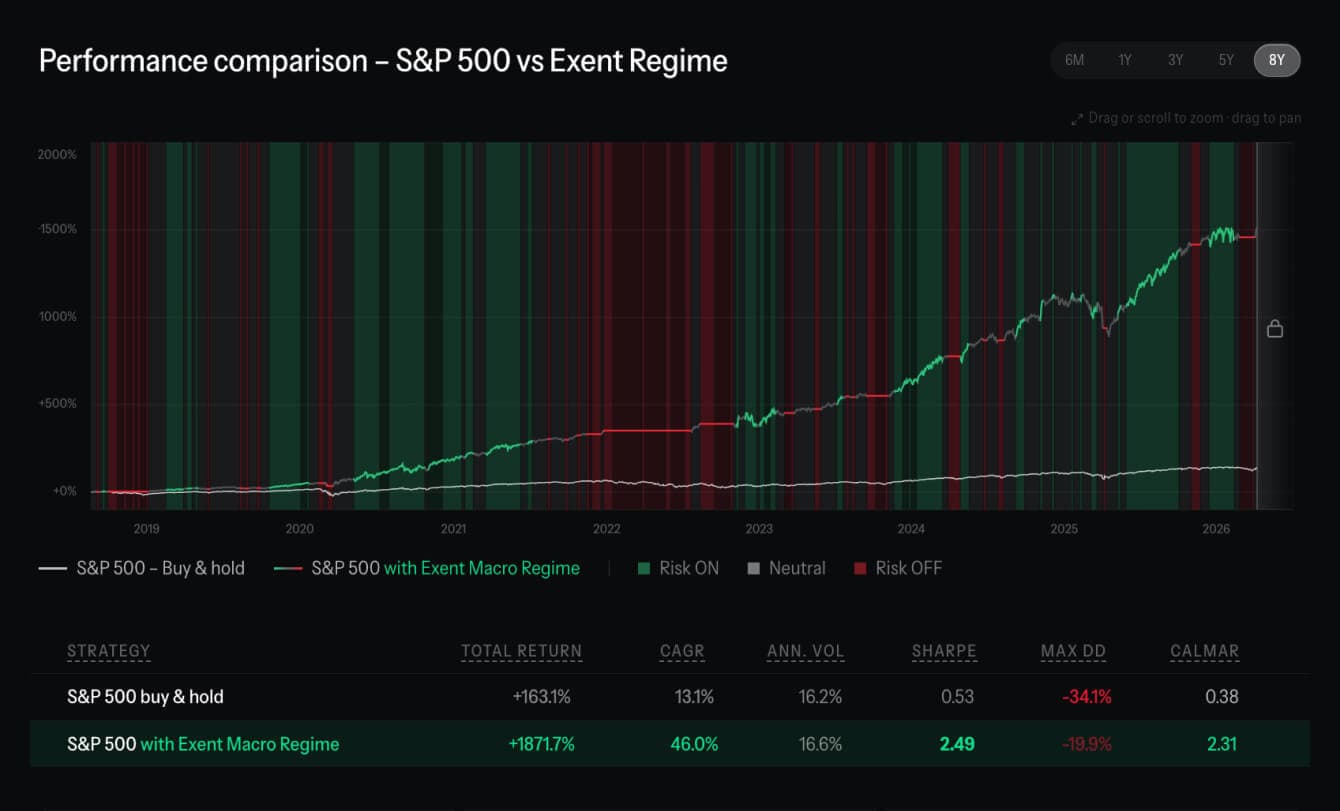
“Exent AI Beat S&P 500 by 10x Over 8 Years”
An eight-year performance analysis of Exent AI’s market regime signal against the S&P 500, as published on Yahoo Finance.
Read full article
Sources
- CNN, Nasdaq sinks more than 2% as investors raise questions about AI debt (Oct 16, 2026)
- Yahoo Finance, Markets news, Oct 16, 2026: Nasdaq, S&P 500 post weekly losses
- The Motley Fool, tech stocks plunge as AI software valuations reverse (Oct 16, 2026)
- investingLive, CoreWeave bonds trade like distressed debt as AI spending outpaces balance sheets (Oct 15, 2026)
- TIKR, Growing AI debt fears sink CoreWeave stock by 15% (Oct 15, 2026)
- Financial Times, Investors dump data centre bonds as AI borrowers face 'Darwin moment' (Oct 15, 2026)
- Forbes, why the 10-year Treasury yield just hit a 24-year high (Oct 7, 2026)
- CMC Markets, third-quarter earnings face exceptionally high expectations (Oct 13, 2026)
- Fox News, Bear Stearns: troubled hedge funds have very little value (Jul 18, 2007)
- Al Jazeera, Europe acts to calm markets (Aug 9, 2007)
- ETF Trends, S&P 500 snapshot: the Oct 9, 2007 record close (1,565.15) and the Mar 9, 2009 low (676.53)
- Federal Reserve Bank of Dallas, Is telecom disconnected or just on hold? (2002)
- Eli Noam, The fundamental volatility of the digital economy (Columbia Business School)
- FRED (St. Louis Fed): Moody’s Baa corporate bond yield minus the 10-year Treasury
- Wikipedia, Closing milestones of the Nasdaq Composite (record close, Oct 6, 2026)
- Federal Reserve, FOMC meeting calendar